If AI can do everything humans do and sometimes even better, what is left for humans to do? Classic question with many answers. I feel it goes to the core of what work is really made of.
All work is rooted in some knowledge work and some judgement work. Judgement without knowledge is useless and biased and knowledge is the foundation to doing any good work. Having gaps in knowledge is an uppermost failure funnel. Having all knowledge but having gaps in understanding is the next step in the failure funnel. It’s really hard to have gaps in judgement when you have plugged all gaps in knowledge and understanding.
From this POV, my mental model is that all good work is a large pyramid, the base of which is knowledge, the middle of which is understanding and the top of which is judgement. Human brains are naturally built to build slim and tall pyramids, which is in a way a visual representation of intuition. You don’t remember every single line in a textbook exactly, but you can have an intuitive grasp over complicated concepts. Case in point - you don’t think of the exact mechanics of the car when driving a car. You have a “feel” for it and you can become so good at it based just on that.
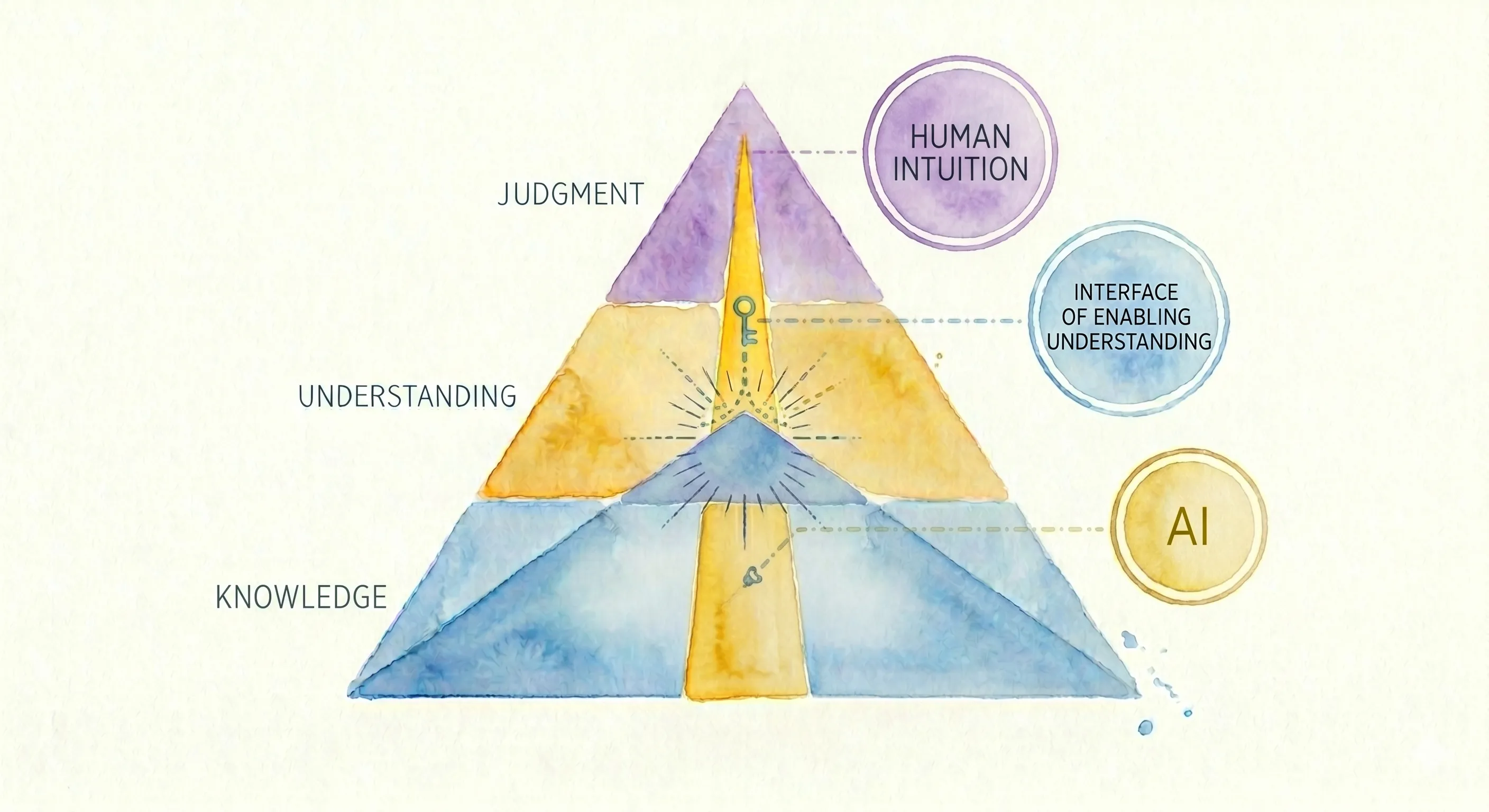
AI on the other hand seems to be really really good at making really wide and short pyramids. Meaning it can recall a massive amount of information exactly, so great for knowledge work. It can judgement calls on simpler things like when to create a separate button for a feature lest it become hard to access. But beyond that making judgement calls in harder things - example representing someone in a legal case in front of a judge. Just knowledge is no more gonna cut it because at that limit, it’s more art than science.
This is basically the theme of thinking fast and slow. AI is good at problems that need thinking slow. Humans are good at problems that need thinking fast. Thinking fast doesn’t happen in the space of language at all - language is too slow. Judgements must be processed in some latent space in our brains that has special properties of being able to wrap around extremely complex and high bandwidth information and slice off from it the core “intuition” out such that this latent space is blazing fast. AI has latent spaces too, but at least today all the “thinking” that models do is in the language space instead of the latent space.
This base gives me a really good starting point to determine how to build AI for myself and the world. Because AI is such a highly generally capable system, one can get lost into nailing down what exactly should one tackle with it. Any solutions trying to judgement work with AI are probably bound to be super steep climbs with higher likelihoods of failure. One might think that isolating AI to knowledge work and humans to judgement work is the right solution here and it is except we have a problem. Humans can’t build tall intuition pyramids out of nothing. They need to have consumed a vast amount of knowledge first to be able to build intuition out of. If you cut out the knowledge bit from humans there is no input for the intuition to be built out of.
The sweet spot of AI x Human combo hence seems to be building the perfect interface between AI and the human - call this the interface of enabling understanding. The goal of this interface should be for AI to capture the knowledge space and repurpose it into understanding, the kind that humans can still build tall intuition pyramids on top of. This is an incredibly tricky thing to do for anyone who has attempted it.